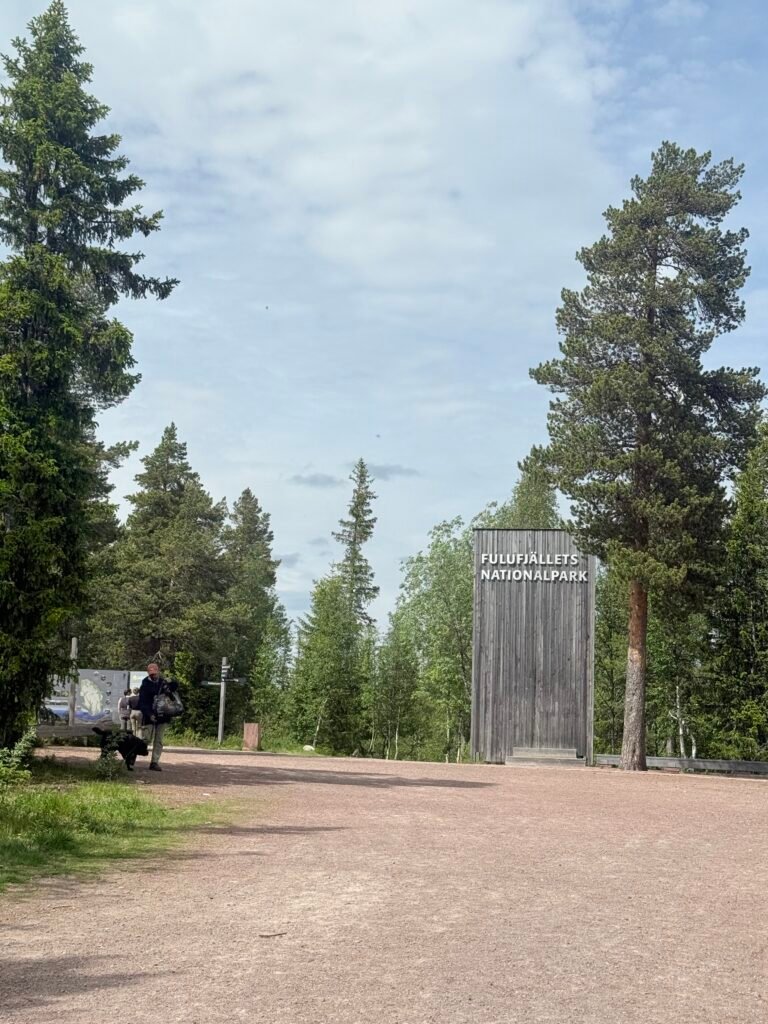
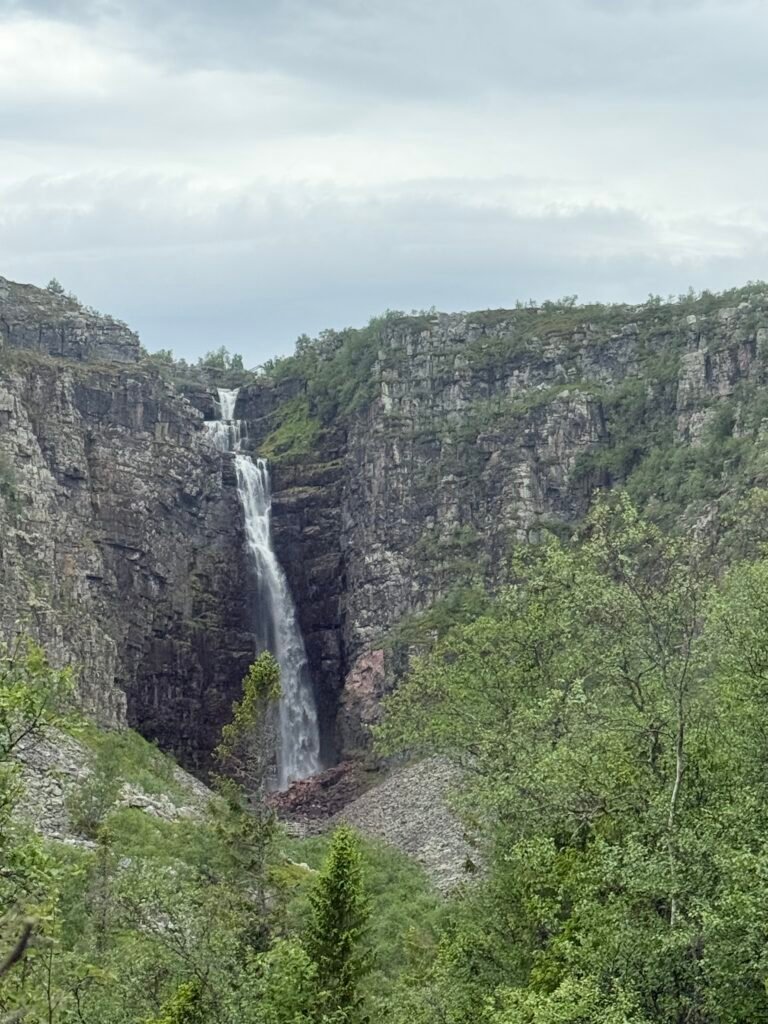
There’s a particular kind of quiet you only find on a Swedish fjäll — the wind moving through dwarf birch, a raven somewhere overhead, and then, faint at first, the sound of falling water. That’s how Fulufjället announces itself. Long before you see Njupeskär, you hear it.
I’d wanted to visit Fulufjället National Park for years. It kept coming up in every “hidden gems of Sweden” conversation I had, always mentioned in the same breath as Sarek or Abisko up north — except this one sits much closer to home, tucked into the northwestern corner of Dalarna, right against the Norwegian border. After finally making the trip, I understand exactly why it holds that reputation.
Where Fulufjället Is and Why It Matters
Fulufjället became a national park in 2002, and it covers about 385 square kilometers of fell, moorland, and old-growth forest. What makes it stand out on the map is its location — it’s the southernmost of Sweden’s mountain national parks, which means it’s the most accessible fjäll wilderness for anyone living in the southern half of the country. You don’t need to fly to Kiruna to feel like you’ve stepped into the mountains. A drive from Stockholm, roughly five to six hours depending on where you’re headed within the park, gets you there.
The nearest village is Särna, and from there the roads narrow, the forest thickens, and the phone signal starts to fade — in the best possible way.
Njupeskär: Sweden’s Highest Waterfall
The park’s star attraction, and the reason most people make the trip, is Njupeskär. It drops a total of about 93 meters, with a clean 70-meter free fall over an ancient sandstone rim — long celebrated as the highest free-falling waterfall in Sweden. The water has been carving into that rock for so long that it’s cut a genuine canyon, with steep, layered walls that make you feel small in the best way.
Standing at the base, looking up through the mist as the water threads down in that long white ribbon, it’s easy to see why so many photographers and hikers return again and again. The trail there is well-marked and manageable, running along the Njupån valley past spruce trees that have stood for four hundred years, so this isn’t a waterfall reserved only for serious mountaineers. Families do this hike. So can you.
A local secret worth knowing: for a handful of mornings around midsummer, between roughly 3 and 5 a.m., the sun angles perfectly into the ravine and lights the falling water a pale, almost otherworldly blue. I didn’t catch it on this trip, but it’s now firmly on my list for a return visit.
Old Tjikko and the Deep Time of Fulufjället
Not far from the falls grows Old Tjikko, a Norway spruce whose root system has been dated at around 9,550 years old, making it one of the oldest living organisms on Earth. It doesn’t look ancient at first glance — the visible tree is a relatively modest, wind-shaped spruce — but that’s the point. It has survived by cloning itself, sending up new shoots for millennia while the harsh climate kept its form low and shrub-like through the cold stretches. Standing next to it, knowing its root system predates the pyramids by thousands of years, put the whole landscape in a different perspective for me.
The 1997 Flood and the Valley of Göljån
Fulufjället also carries a scar from more recent history. In 1997, an extraordinary rainstorm dropped around 400 millimeters of rain in a single day — still the heaviest 24-hour rainfall ever recorded in Sweden. The swollen Göljån river tore through its valley, stripping vegetation and reshaping the terrain almost overnight. Walking that valley today, the exposed rock and altered channels still tell the story, a reminder of just how much power these quiet mountain landscapes can hold.
Hiking, Wildlife, and What to Bring
Fulufjället has around 140 kilometers of marked trails, ranging from short boardwalk loops near the Naturum visitor center to multi-day routes deep into the wilderness zone, where about 60% of the park is protected as untouched land with almost no infrastructure. This is bear and lynx country, and the Siberian jay — bold, curious, and often willing to approach hikers — is something of an unofficial park mascot. I saw moose tracks along the trail, though the moose themselves stayed sensibly out of sight.
If you’re planning your own trip:
- Best season: June through September for hiking; the falls freeze into a dramatic ice formation in winter, drawing experienced ice climbers.
- Start point: Naturum Fulufjället, the visitor center near Mörkret, which has maps, exhibits, and a café.
- Parking: Arrive early in July and August — the main lot fills up fast.
- Gear: Sturdy boots are non-negotiable. Parts of the terrain near the ravine are steep and can be slippery, especially after rain.
A Northern Escape Worth the Drive
What struck me most about Fulufjället wasn’t just the scale of Njupeskär, impressive as it is — it was how much history is layered into one relatively compact park. A waterfall carved over millennia, a tree older than written language, and a landscape still visibly reshaped by a storm less than thirty years ago. It’s Sweden’s wild north condensed into a few hours’ drive from the south, and it more than earns its place on any serious Sverige travel list.
If Fulufjället isn’t on your Sweden itinerary yet, it should be.
Varma hälsningar,
Sydul